Power, water, HVAC, compressed air, process gases, and drains keep operations running. They're also the systems most often under-scoped early and expensive to retrofit late.
Utility requirements usually live in someone's head, or scattered across old equipment cut sheets and vendor quotes. Utilities documentation catalogs every requirement — electrical, mechanical, process gases, chemical drains, facility systems — by zone and by piece of equipment, in one organized matrix.
Built at the concept stage, while equipment and process requirements are still evolving, it's the format MEP engineers can actually design from — instead of discovering mid-construction that a zone needs three-phase power, chilled water, and nitrogen it was never scoped for.
Equipment or process requirements are still evolving and you need utility planning that can keep pace with design, not lag behind it.
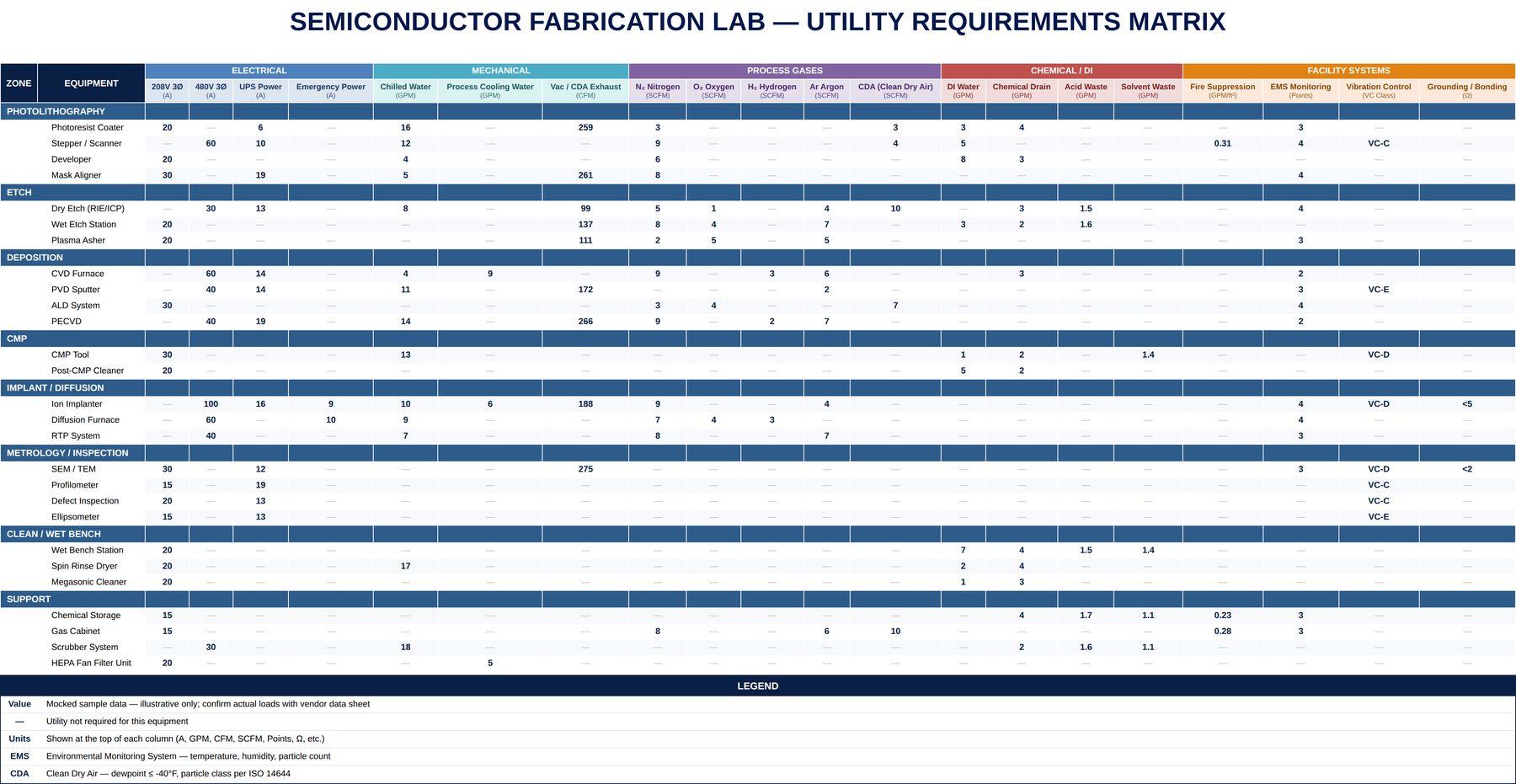
A semiconductor fabrication lab utility requirements matrix — the format used to catalog power, compressed air, water, drains, gases, and HVAC needs by area for handoff to design teams. Values shown are for demonstration only.
27 pieces of equipment tracked across ~20 utility types, zone by zone208V/480V power, UPS, emergency power, chilled and process cooling water, vacuum and clean dry air exhaust.
Nitrogen, oxygen, hydrogen, argon, and clean dry air, scoped per piece of equipment.
DI water, chemical and acid drains, solvent waste, fire suppression, environmental monitoring, vibration control, and grounding.
Most engagements start with a quick conversation about where you are in the process.
Get In Touch